
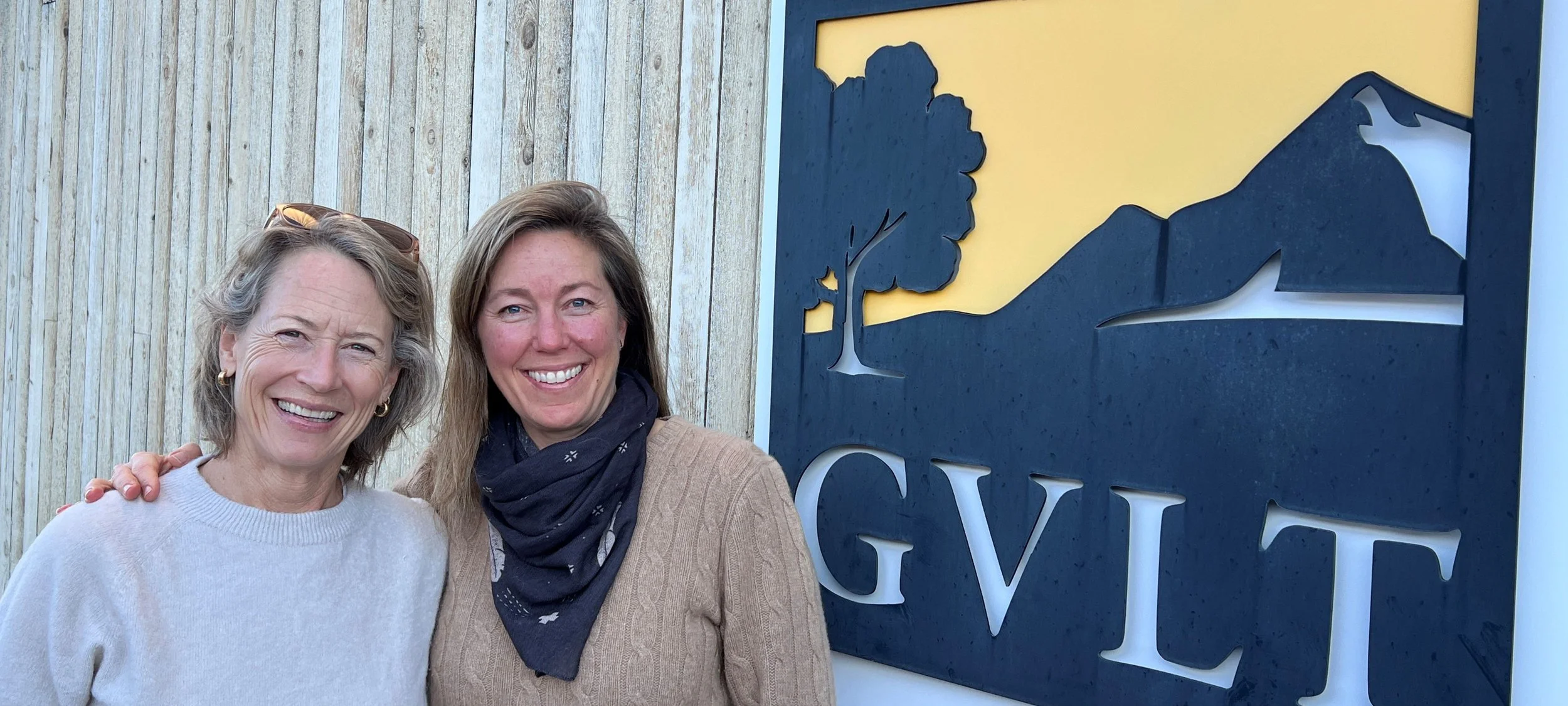
Lisa Rickenbaugh and Anna Patterson
As we continue our Groundwork blog series, we were thrilled to sit down with our two creative partners to talk about their personal connection to Southwest Montana’s landscape and how it inspires them.
Groundwork is a year-long collaborative initiative that brings together Gallatin Valley Land Trust, textile designer Lisa Rickenbaugh (founder and creative director at Bellwether Handwoven), and painter Anna Patterson (A.T. Patterson Design). Over the course of the project, we’ll follow Lisa and Anna as they translate the beauty of conserved landscapes into tactile works of art, culminating in summer 2027 with a farm-to-table dinner at Little Star Diner, where their original works will be sold to support the continued protection of the highly productive, wildlife-rich, and scenic open lands that inspired them.
Meet Lisa and Anna
Lisa Rickenbaugh founded and owned Heyday in downtown Bozeman before selling it in 2019. Over a year ago, she launched Bellwether Handwoven, creating home goods including pillows, throws, tabletop pieces, and pouches. Bellwether textiles are crafted from “fleece grown on sheep from small Montana farms, yarn that is processed at local mills, and distinctive design woven by skilled artisans—making its supply circle traceable, sustainable, and supportive for a newly imagined textile standard.”
Anna Patterson is well known for her stunning landscape paintings, though many people would be surprised to learn she has only been painting professionally for the past decade. After studying printmaking in college and building a career in graphic design, she eventually turned her focus to the medium that had long called to her. You can find her original paintings, as well as prints, scarves, and cards, on her A.T. Patterson website. Be sure to check out her 2026 collection, which was released on November 20.
Q&A: Rooted in Landscape
How does Southwest Montana’s landscape inspire you?
Lisa: I grew up on a small, 11-acre dairy farm outside of Boston—an oddity in a very suburban area. Over the years, it grew into a dairy farm milking around 30 cows. When milk sales weren’t enough to support the farm, my mother went to cheesemaking school in Canada and came back to set up a small manufacturing area to make Camembert cheese. We sold the cheese to gourmet shops all over the greater Boston area, and my brother and I ran the delivery truck. Cheese was my first taste of artisan craft. Ever since, I have been fascinated with that idea: What can we make and sell—using raw materials, turning them into something meaningful, and getting it out into the world?
Moving out West felt like coming to the land of possibility. There's a culture that I found enticing. People think differently about agriculture and open space. The land’s expansiveness and vastness, the blue sky, and the mountains are why I moved here.
I consider the work I do to be a counterbalance to mass production, celebrating what can be made by hand. If we keep small farms alive, they can continue to do the work they do. We all can support them and encourage their growth and stability by purchasing their goods. That’s the inspiration that I find: keeping land in agriculture at some level. GVLT plays an important role in conserving open space and agriculture, which in turn helps keep local mills and ranches healthy and productive.
Anna: For me, it is the incredible beauty of the land that is my ultimate inspiration. In large part, I moved to Montana because of that beauty. I drove into town in early August, over 20 years ago, and went to dinner at a friend’s house in Springhill overlooking the entire valley. In that moment, the sunset took over the entire sky—I hadn’t seen anything like it. Pure magic.
I am impressed by the landscape in every season. The colors, the textures, the light. I watch and notice the changes, the shapes, the compositions. I am a constant observer. I take photos everywhere I go. Those extra beautiful moments can happen at any time—often when simply driving to the store. I feel so lucky to be able to say that, but that is what it is to live in Montana. Those everyday but special moments captured are what I often use to paint from.
What emotions come up when you think about the landscape?
Lisa: It’s the big deep breath that I can take when I pass the airport on the way out to the Wool Mill or Springhill Road. When you see all that land—it’s a peace-of-mind moment.
Anna: The landscape gives me a feeling of calm but also delight. I am constantly in awe of its wild beauty, its ability to transform. The land’s array of color is absolutely endless. I find myself often overwhelmed with the extreme beauty of the land around us.
What would happen if these open lands disappeared?
Lisa: Many ranches and farms have already shuttered, and plenty of family farms have been sold for development. Farming is a good livelihood for a family and a great environment for children to grow up in, and it’s important that the people who want to do that work can make a real living on the land. I want to support the work they do, so perhaps we won't have to look at the complete absence of those working lands in the future. Preserving these special places feels important.
Anna: I feel a great need to protect those open spaces around us. It is that land that makes this place so special. I am passionately drawn to the beautiful wide-open land that gives us all a sense of peace and endless inspiration. It feels critical to preserve that.
Seeing growth happen so quickly in our community can feel frustrating and uncontrollable. Having the access that we do here and experiencing our open spaces has certainly impressed upon me that mindful growth and stewardship today is vitally important and truly shapes the future of our valley.
Stay tuned for the next article in this series when we join Lisa and Anna on visits to some of the conserved properties inspiring this project and have the opportunity to talk with the landowners who are choosing to protect open space for generations to come.